

In the realm of industrial applications, rubber washers play a crucial role in ensuring the integrity and functionality of various systems. Among the different types of rubber washers available, Nitrile Butadiene Rubber (NBR) washers stand out for their unique properties and versatile uses. One of the key performance indicators of NBR washers is their creep resistance, which significantly impacts their long - term effectiveness in seals and gaskets.
Understanding Creep in Rubber Washers
Creep is a phenomenon where a material undergoes a gradual and permanent deformation under a constant load over time. In the context of rubber washers, when they are compressed between two surfaces to create a seal, they are subjected to a continuous pressure. If the rubber has poor creep resistance, it will slowly deform, losing its original shape and thickness. This can lead to a loss of sealing pressure, potentially causing leaks in the system.
For example, in an automotive engine, NBR washers are used in various applications such as around fuel injectors or oil filters. If the NBR washer has insufficient creep resistance, over time, it may deform and fail to maintain a proper seal. This can result in fuel or oil leaks, which not only cause environmental hazards but also pose a safety risk and may lead to engine damage.
Factors Affecting the Creep Resistance of NBR Washers
Chemical Composition
The chemical makeup of NBR significantly influences its creep resistance. NBR is a copolymer of acrylonitrile and butadiene. The ratio of acrylonitrile to butadiene in the polymer chains affects the physical and mechanical properties of the rubber. A higher acrylonitrile content generally leads to better oil resistance, hardness, and lower gas permeability. At the same time, it also has an impact on creep resistance.
When the acrylonitrile content is increased, the intermolecular forces within the rubber structure become stronger. The polar acrylonitrile groups attract each other, creating a more rigid and stable network. This means that when the rubber is subjected to a constant load, the polymer chains are less likely to flow and deform, resulting in better creep resistance.
However, too high an acrylonitrile content can also make the rubber more brittle, reducing its flexibility and resilience. As a supplier of NBR washers, we carefully select the appropriate acrylonitrile - butadiene ratio to balance the need for creep resistance with other important properties such as flexibility and elongation.
Cross - linking Density
Cross - linking is the process of chemically bonding the polymer chains in the rubber to form a three - dimensional network. The density of these cross - links in NBR washers is a critical factor in determining their creep resistance. A higher cross - linking density restricts the movement of the polymer chains.
When a cross - linked rubber is under load, the cross - links act as anchors that prevent the chains from sliding past each other easily. This results in less deformation over time and better creep resistance. We use advanced cross - linking techniques during the manufacturing of our NBR washers to achieve an optimal cross - linking density. This not only enhances creep resistance but also improves other mechanical properties such as tear strength and abrasion resistance.
Temperature and Environment
The operating temperature and environment have a significant impact on the creep resistance of NBR washers. At higher temperatures, the molecular mobility of the rubber increases. The polymer chains become more flexible and are more likely to deform under a constant load.
Moreover, exposure to certain chemicals, oils, and solvents can also affect the structure of the NBR. For example, if an NBR washer is exposed to a chemical that swells the rubber, it can disrupt the cross - linked network and reduce the creep resistance. We provide NBR washers with different formulations to suit various temperature ranges and environmental conditions. For high - temperature applications, we use special additives and cross - linking agents to maintain the creep resistance of the washers.
Measuring the Creep Resistance of NBR Washers
To accurately assess the creep resistance of our NBR washers, we use a variety of testing methods. One of the most common methods is the compression set test. In this test, a sample of the NBR washer is compressed to a specific percentage of its original thickness and then held under a constant load at a specified temperature for a defined period.
After the test period, the load is removed, and the washer is allowed to recover. The compression set is then calculated as the percentage of the original thickness that the washer fails to regain. A lower compression set value indicates better creep resistance.
We also conduct long - term simulation tests where the washers are subjected to real - world conditions over an extended period. These tests take into account factors such as cyclic loading, temperature variations, and exposure to different chemicals. By analyzing the data from these tests, we can continuously improve the design and manufacturing process of our NBR washers to enhance their creep resistance.
Comparing NBR Washers with Other Types of Rubber Washers
NBR washers are often compared with other types of rubber washers in terms of their performance characteristics, including creep resistance.
EPDM Washers
EPDM Washers are known for their excellent weather resistance and resistance to ozone, UV radiation, and many chemicals. EPDM has a relatively lower creep resistance compared to NBR in applications where oil and fuel resistance are also required. However, in non - oil and non - fuel environments, EPDM washers can be a suitable choice, especially when long - term exposure to outdoor conditions is expected.
Viton Flat Washers
Viton Flat Washers are made from fluorocarbon rubber and offer outstanding resistance to high temperatures, fuels, and chemicals. Viton generally has better creep resistance than NBR at extremely high temperatures and in aggressive chemical environments. But the cost of Viton washers is usually higher than that of NBR washers. So, for applications where the temperature and chemical exposure are not extremely severe, NBR washers can provide a more cost - effective solution with acceptable creep resistance.
Neoprene Washers
Neoprene Washers are widely used in applications where good general physical properties, such as moderate oil resistance, weather resistance, and elasticity, are required. In terms of creep resistance, NBR washers tend to perform better in oil - based applications compared to neoprene washers. Neoprene may have a relatively higher creep rate, especially when exposed to oils and greases for an extended period.
Applications of NBR Washers with High Creep Resistance
The high creep resistance of our NBR washers makes them suitable for a wide range of industrial applications.
Automotive Industry
In the automotive sector, NBR washers are used in fuel systems, engine oil systems, and brake systems. Their ability to maintain their shape and sealing performance over time is crucial for the reliable operation of vehicles. For example, in fuel injection systems, the high creep resistance of NBR washers ensures a tight seal, preventing fuel leakage and ensuring optimal engine performance.
Hydraulic and Pneumatic Systems
In hydraulic and pneumatic systems, NBR washers are used as seals to prevent fluid leakage. The constant pressure in these systems requires the washers to have good creep resistance to maintain a reliable seal. Our high - quality NBR washers can withstand the pressure fluctuations and long - term loading in these systems, reducing the risk of system failures.
Industrial Machinery
Industrial machinery often operates under harsh conditions, including high temperatures, pressures, and exposure to various chemicals. NBR washers with good creep resistance are used in machinery components such as pumps, valves, and compressors. They help to ensure the proper functioning of the machinery and prevent leaks that could lead to costly downtime.
Conclusion
The creep resistance of NBR washers is a critical property that determines their long - term performance in various industrial applications. Through careful control of factors such as chemical composition, cross - linking density, and considering the operating temperature and environment, we can produce high - quality NBR washers with excellent creep resistance.
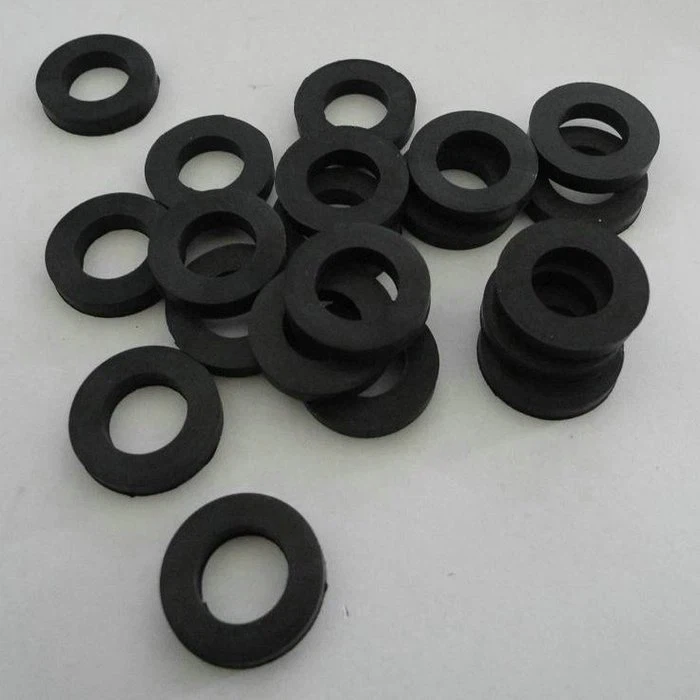

When compared to other types of rubber washers, NBR washers offer a good balance between performance and cost, making them a popular choice in many industries. If you are in need of high - quality NBR washers with superior creep resistance for your specific application, we would be more than happy to discuss your requirements. Contact us to learn more about our product range and start a procurement negotiation that can help you achieve the best results for your projects.
References
- ASTM D395 - Standard Test Methods for Rubber Property - Compression Set.
- P. S. Khanna, Rubber Technology Handbook, Hanser Gardner Publications, 2005.
- C. P. Rader, J. H. Bhowmick, The Science and Technology of Rubber, Academic Press, 2013.